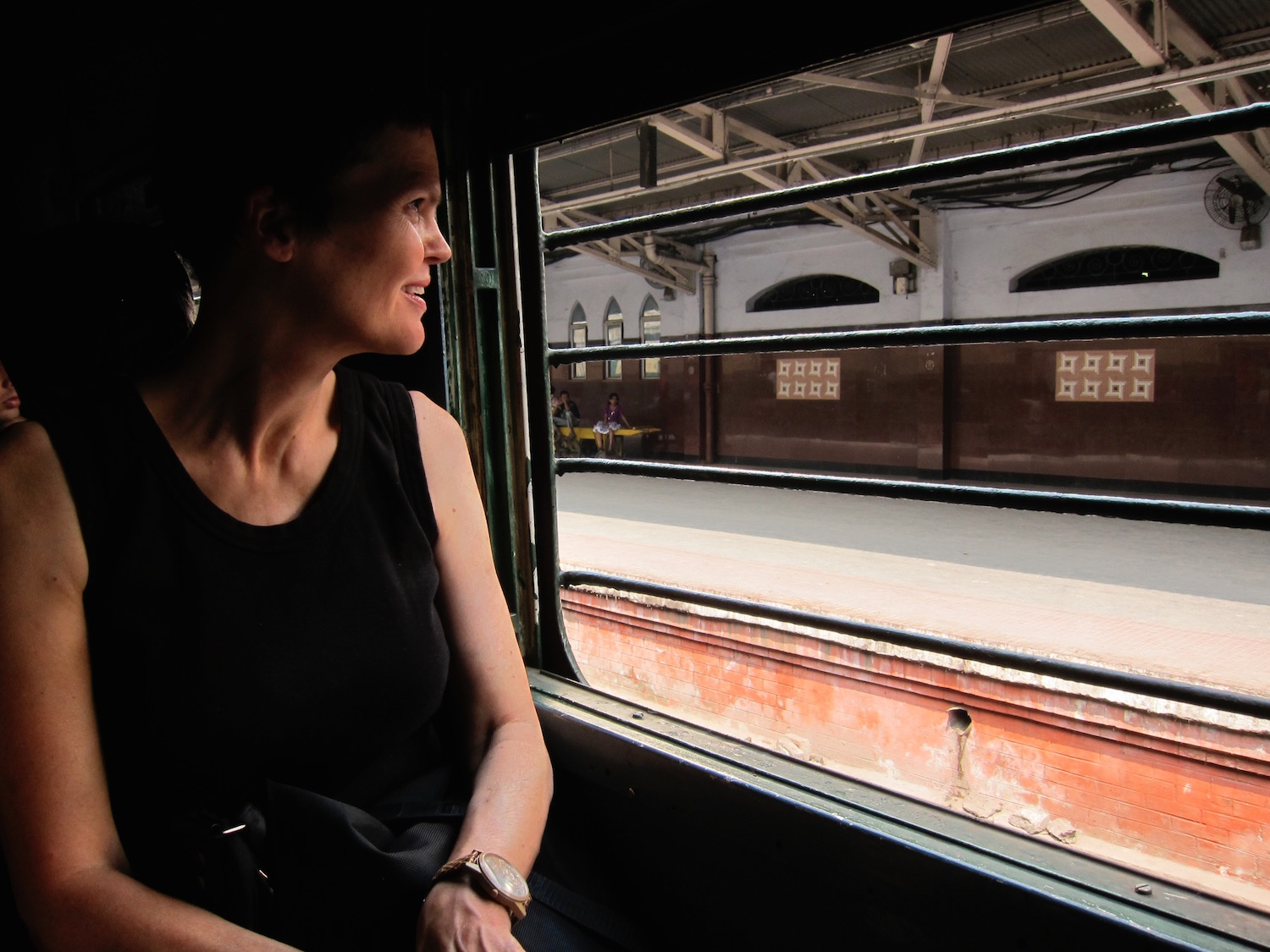

Carol Rhodes was a defining figure in contemporary British painting, renowned for her unique take on the industrial landscape. Her small-scale, intricately detailed works reimagined peripheral terrains as spaces of psychological tension. Through her art, Rhodes explored the profound ways in which humans reshape their environment and, in turn, adapt to the consequences of those changes. Read more on edinburghka.
Early Years and Artistic Journey
Carol Mary Rhodes was born in Edinburgh on 7 April 1959, but her upbringing was defined by a constant movement between worlds, cultures, and values. Her father, William Rhodes, was a doctor and theologian, while her mother, Helen Macdonald, was a former detective. Both were missionaries for the Church of Scotland, a calling that dictated the family’s early years. Carol grew up in India—first in Nagpur and later in Serampore, Bengal—immersed in the academic community of Serampore College where her parents worked.
At the age of 14, Rhodes returned to the UK. The family settled briefly in Sussex before moving to Dumfries to allow Carol to complete her O and A Levels. Her teenage years were a whirlwind of different secondary schools, fostering a lingering sense of transience. Despite struggling to adjust to the cold British climate, she chose to remain in the UK when her parents eventually returned to India. In 1977, she enrolled at the Glasgow School of Art (GSA), studying painting under the influential realist Alexander Moffat.
Throughout the 1980s, Rhodes became a linchpin of the Glasgow cultural scene. She organised events at The Women’s Centre Glasgow and served on the committee of the Transmission Gallery. In 1987, alongside writers Alasdair Gray and James Kelman, she co-founded the Glasgow Free University—an alternative space for intellectual exchange outside the rigid confines of academia. She balanced her activism with roles as an assistant at the Third Eye Centre and a part-time technician at Tramway and the CCA, seamlessly weaving her practical work into her commitment to artistic and political communities.
Rhodes’ return to painting after a near decade-long hiatus marked a powerful new chapter. By the mid-1990s, she was teaching at the GSA and renting a studio in the school’s main building. In 1994, she debuted her new work in Glasgow and Edinburgh, later featuring in the landmark exhibition The Persistence of Painting at the CCA. She bypassed traditional nature, choosing instead to focus on man-made or radically altered landscapes. Her canvases became populated with quarries, power stations, reservoirs, and car parks—utilitarian sites often dismissed as having no aesthetic value.
In 2012, Rhodes noticed a persistent weakness in her knee. By late 2013, she received a devastating diagnosis: Motor Neurone Disease. From that point on, time began to contract. She moved from using a walking stick in 2014 to a wheelchair in 2015. By late 2016, she was forced to stop painting entirely. For an artist whose primary language was visual, this was a painful but stoically accepted reality. She attended her final exhibition in 2017 and passed away at her home in Glasgow on 4 December 2018.
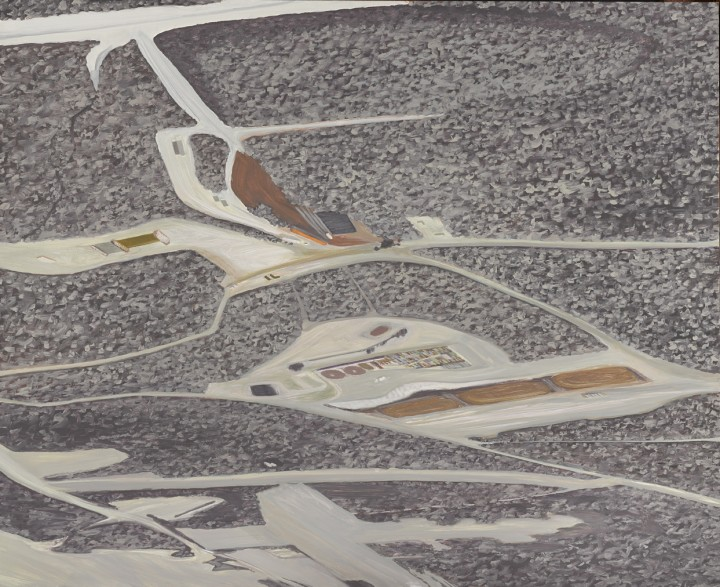
Trees and Works, 2001
Recognition and Artistic Legacy
Over a career spanning 25 years, Carol Rhodes developed a signature style of landscape painting that shone a light on the industrial fringes typically ignored by the art world. Her palette—muted, earthy, and almost flesh-like—heightened a sense of unease and ambiguity, making her landscapes feel psychologically charged yet visually disciplined. It was this unwavering, purposeful exploration of “hidden landscapes” that cemented her reputation as one of the most distinctive voices of her generation.