

Throughout history, women have always been resourceful, managing to carry everything they might possibly need. It’s no coincidence there’s a saying that you can find absolutely anything inside a woman’s handbag. However, the ladies’ handbag as we know it today only appeared in the early 20th century. So, what did women use before that? For carrying useful small items, women of Edinburgh used an intriguing accessory—the chatelaine. Simple in design yet highly functional, it even briefly became a fashionable element of women’s attire. So, what exactly did Edinburgh women use a chatelaine for, and how might we encounter this unusual item today? Let’s explore these and other fascinating details in this article from Edinburghka.
Everyday Item or Luxury Object?
To put it briefly, a chatelaine was both. It was indispensable for housekeepers or senior women in affluent Edinburgh households. At the same time, elegantly adorned and decorated with precious stones, it could easily appear as part of an aristocratic lady’s evening attire. To better understand its purpose, let’s begin with its origin.
The name “chatelaine” comes from the French word châtelain, meaning “keeper of the castle.” First appearing in the 16th century as a women’s accessory, the chatelaine consisted of a clasp with dangling chains, fastened to the belt. Various essential items could be suspended from these chains (occasionally cords), depending on the needs of its wearer. For example, a housekeeper’s chatelaine might hold keys to various doors, cabinets containing expensive dishes, as well as tools for winding clocks and sewing. True to its name, the accessory instantly signalled who the “lady of the castle” was.ʼ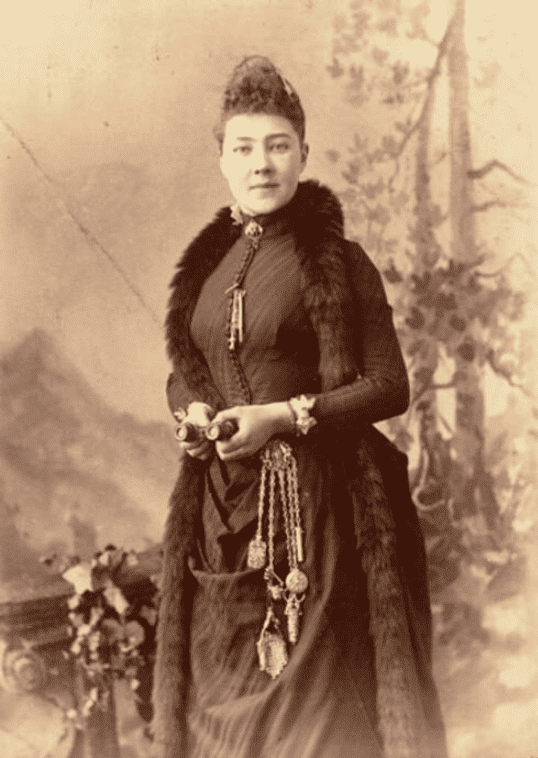
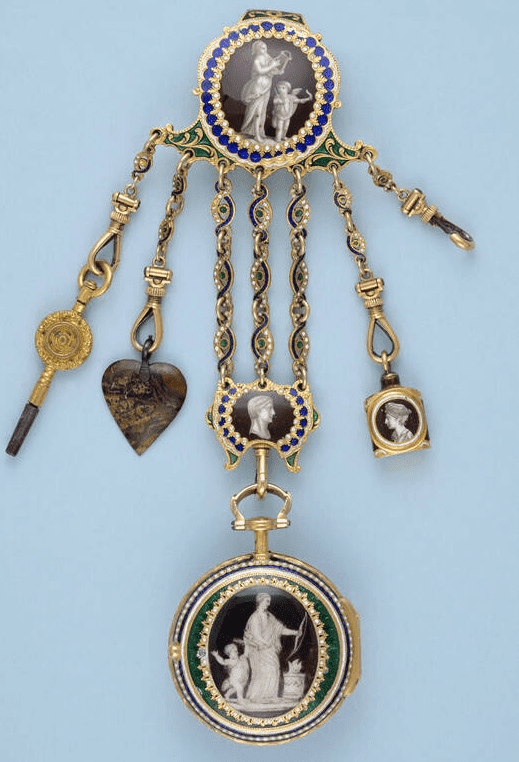
From the 18th century onwards, the chatelaine also became a fashionable accessory. Middle-class women typically wore chatelaines made from iron, copper, or brass. Wealthy women, on the other hand, could afford gold or silver chatelaines engraved with their initials, often adorned with gemstones. During balls and formal events, Edinburgh’s noble ladies never missed an opportunity to dazzle each other with their richly decorated chatelaines.
The high demand for this accessory encouraged jewellers and metal artisans to experiment with different styles and forms. Chatelaine design rapidly evolved during the 18th century, resulting in items that were simultaneously beautiful and practical. In addition to the standard set of suspended items, a chatelaine often included an étui—a small cylindrical case. Today, we’d call this a miniature manicure set. Typically, the étui contained:
- manicure scissors;
- nail files;
- tweezers;
- a combination toothpick and ear scoop;
- a folding knife;
- a leather bookmark;
- a pencil.
Chatelaine: The Ancestor of Modern Keychains?
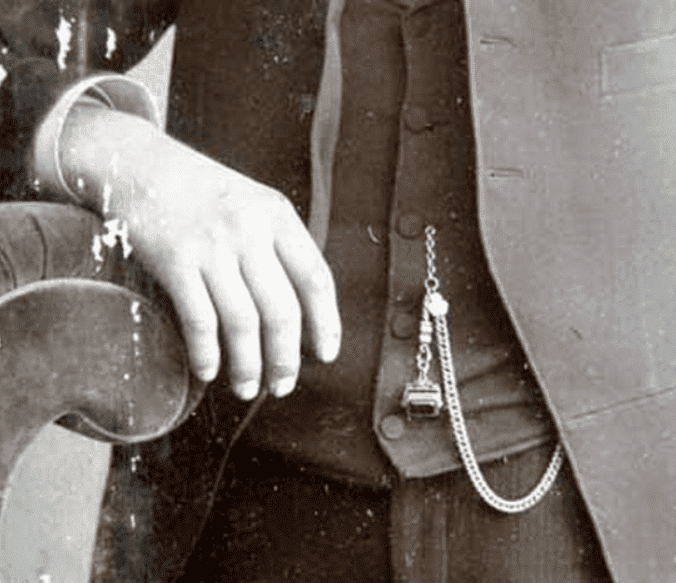
In some ways, yes. The way men wore chatelaines in the 18th and 19th centuries was quite reminiscent of today’s keychains. Men’s chatelaines usually had just one or two pendants, intended for securing a pocket watch and a few keys. Only affluent men could afford such an accessory. A gold or silver chatelaine with an expensive pocket watch immediately conveyed the owner’s high status.
Chatelaines gradually fell out of everyday use at the beginning of the 20th century, as clothing items gained convenient pockets, and necessary items could now be carried in leather or fabric handbags. The World Wars brought difficult times, and this fashionable accessory became an unaffordable luxury. Additionally, openly displaying valuables became dangerous. Yet, the history of the chatelaine did not end—it merely paused.
In the late 20th and early 21st centuries, these accessories underwent a transformation, receiving a second life from renowned jewellery brands. So, what constitutes a chatelaine in modern Edinburgh? Today, it might be a brooch or clip with dangling chains. It can also be a pair of brooches connected by chains of varying lengths. These look especially charming when pinned to a woman’s collar or shoulder. Any contemporary Edinburgh woman can feel like a lady from bygone eras simply by adding a beautiful chatelaine to her outfit.