

When you see a man wearing a tartan skirt, you immediately know he comes from Scotland. Indeed, the first kilts appeared in Scotland. But not everyone knows that the traditional kilt is not just a skirt, but an entire national costume made up of several items of clothing and footwear.
It includes:
- A shirt;
- A woollen jacket;
- A plaid worn over the shoulder;
- Knitted socks (hose);
- Shoes with metal buckles;
- A beret with a pompom (sometimes with a feather);
- A leather pouch worn at the hips (sporran).
This ensemble was not shaped by fashion, but by various historical and cultural factors. In modern Edinburgh, you can purchase not only a traditional kilt but also designer versions. The kilt has a fascinating history. More on edinburghka.
What is a Kilt?
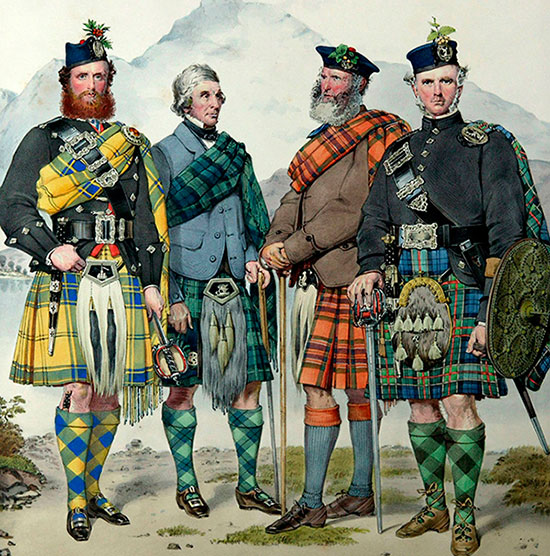
The name “kilt” itself means “clothing wrapped around the body.” The Scots borrowed it from the Vikings, for whom “kjilt” translated as “pleated.” The first written mentions of the kilt can be found in a document from 1578. Furthermore, a stone carving from the seventh century, located in the village of Nigg, depicts a man in a kilt. The history of the Scottish kilt spans hundreds of years. It began with the appearance of the “great kilt” in the daily life of the average Scot – a large plaid that was versatile in Scotland’s natural conditions. It was a long piece of woollen fabric, up to 7-8 metres in length, which was draped around the waist to form pleats. The upper part of the fabric was thrown over the shoulder, providing protection from the wind and cold. At night, the kilt transformed into a warm blanket. The material for the kilt was tartan – a woollen fabric with a chequered pattern. Centuries later, when the kilt became popular and was the main form of clothing in the country, different coloured tartans signified allegiance to a particular Scottish clan.
Recognising its practicality, the kilt was widely adopted as a military uniform. With its military use came an accessory without which the modern national costume is hard to imagine: the sporran, a leather pouch worn on a belt. It served several functions:
- It protected the groin area from arrows during battle;
- It prevented the front of the kilt from lifting up;
- It acted as a pocket for storing small items, as the traditional kilt had no pockets.
Who Wore the Kilt and How?
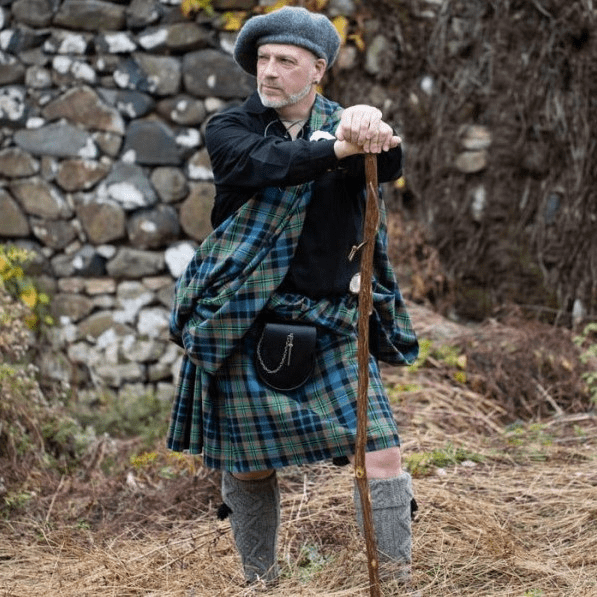
The kilt was traditionally worn by the Highlanders of Scotland for several reasons. Firstly, in the harsh, rainy climate of the Scottish Highlands, the kilt was practical – it provided freedom of movement, offered warmth, and dried quickly.
Secondly, it was indispensable in times of war – it allowed for maximum freedom of movement and could always be easily cast off in an emergency.
Thirdly, the kilt was a symbol of Highland culture, representing their courage, bravery, and freedom.
It was only in the mid-18th century, after the Jacobite uprising, that the kilt became a symbol of national identity and began to spread among other Scots. It became popular in Edinburgh towards the end of the 18th century.
Putting on a great kilt was not so simple; the skill took months to master. To do it correctly required a sequence of actions:
- Lay out the fabric. The entire piece of cloth was spread out on a flat surface.
- Determine the front section. A section of fabric that would serve as the front apron of the kilt was measured out. Its width should be half the circumference of the hips.
- Form the pleats. On the section following the front apron, pleats were carefully gathered. One layer of fabric was used to form the pleats, while the other remained smooth.
- Position the belt. A belt was placed underneath the fabric where the pleats ended, with the buckle on the right-hand side.
- Secure the fabric. Both parts of the fabric, the pleated and the smooth sections, were wrapped around the waist and secured with the belt.
- Arrange the upper part. The remaining free part of the fabric was thrown over the shoulder or used as a cloak.
The Appearance of the Small Kilt
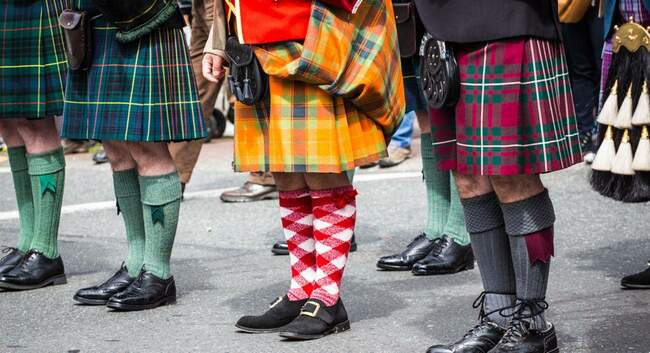
The small kilt, which resembles the modern pleated skirt familiar to Scots today, appeared in the early 18th century. It became a more convenient and practical alternative to the great kilt. Although the great kilt provided excellent protection from the cold and wind, it was bulky and impractical for physical labour.
There is a legend in Scotland about an Englishman named Thomas Rawlinson, who played a key role in the creation of the small kilt. The story goes that Rawlinson, having made a deal with one of Scotland’s most influential clans (the MacDonells), began working with local Highlanders. He noticed that their traditional clothing was unsuitable for physical labour and decided to modify it. Thomas instructed a tailor to cut off the upper part of the great kilt, leaving only the lower section. This resulted in the small kilt – a separate garment with the pleats already sewn in. This design was more convenient for workers and quickly gained popularity among the Highlanders.
The Modern History of the Kilt
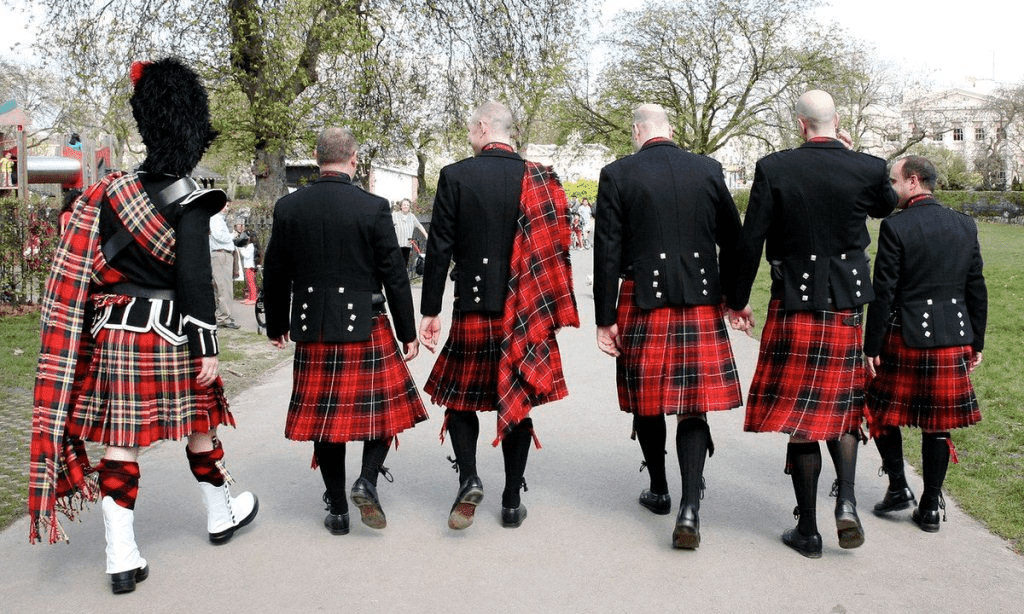
The modern version of the kilt differs little from those of past centuries. A variety of materials allows the national costume to be made as either a budget-friendly option or a luxurious one for formal events. The kilt’s tartan still indicates allegiance to one of Scotland’s clans. There is also a universal tartan – a green one, which is considered the national pattern. Interestingly, Scotland has a special register of tartan patterns, where each design is assigned a “cindex” – a code of numbers and letters. It is also possible to register your own personal tartan, dedicating it to any special occasion. A kilt made from such exclusive material can make its owner truly unique at any celebration.
The kilt is a source of pride and a cultural heritage for every Scot. Edinburgh residents wear it for official events such as weddings and graduation balls. A custom-made kilt outfit is considered an expensive and honourable acquisition, and it can be kept in a Scottish man’s wardrobe for a lifetime.