

Café · Edinburgh · ⭐ 9.1/10 · 2066 reviews · updated: 2026-08-10 17:32:52
Address: 2 Nicolson St, Edinburgh EH8 9DH, United Kingdom
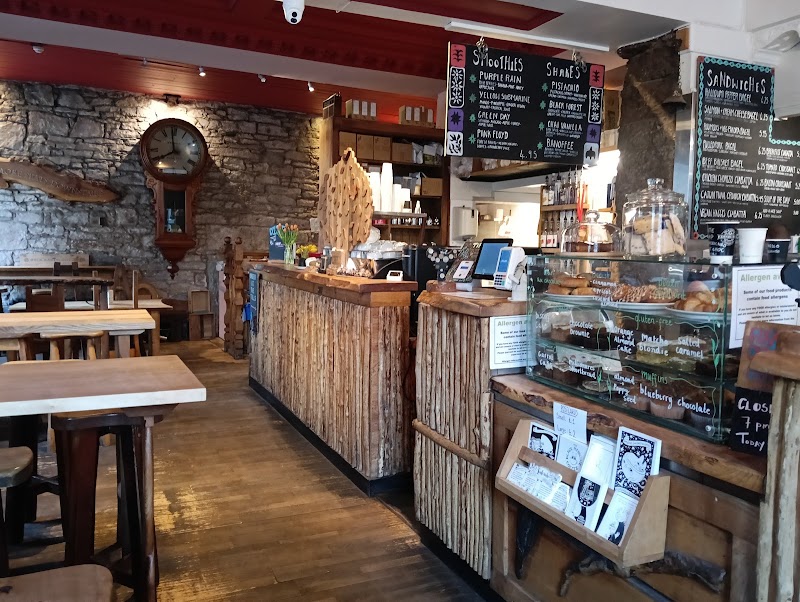
Some cafés open with a manifesto. Black Medicine Coffee Co simply outlasted everybody else. It has been pouring coffee on Edinburgh’s Southside since 1998, from a room of heavy stone and solid timber that reads less like a coffee shop than like the inside of a very well kept log cabin somebody buried at the foot of the Old Town ridge. Two decades of students have written essays at these tables, and the place carries the worn, unhurried confidence of somewhere that never had to reinvent itself in order to stay busy.
Highlights
- Trading since 1998 — a rare thing in a city centre where coffee bars turn over every few years, and long enough that people who revised for finals here now send their own students in.
- A name with a story behind it — the café says it was named on the notion that the native peoples of America once called coffee black medicine, and it has never been tempted to soften that into something friendlier.
- Local beans in the hopper — the house espresso is the Griffin blend from the Edinburgh Tea and Coffee Company, a medium-dark roast with nutty, chocolatey weight.
- A cellar that doubles as a study hall — the business started upstairs and later extended down into the vaulted room below, and that lower floor is now where the laptops and the reading lists live.
- Two dozen syrups behind the counter — an honest signal that this is a broad church rather than a purist filter bar, and nobody here will make you feel strange for ordering something sweet.
- One site, and only one — satellite branches came and went over the years, and what survived is the original, which is rather the point.
What’s in the cup
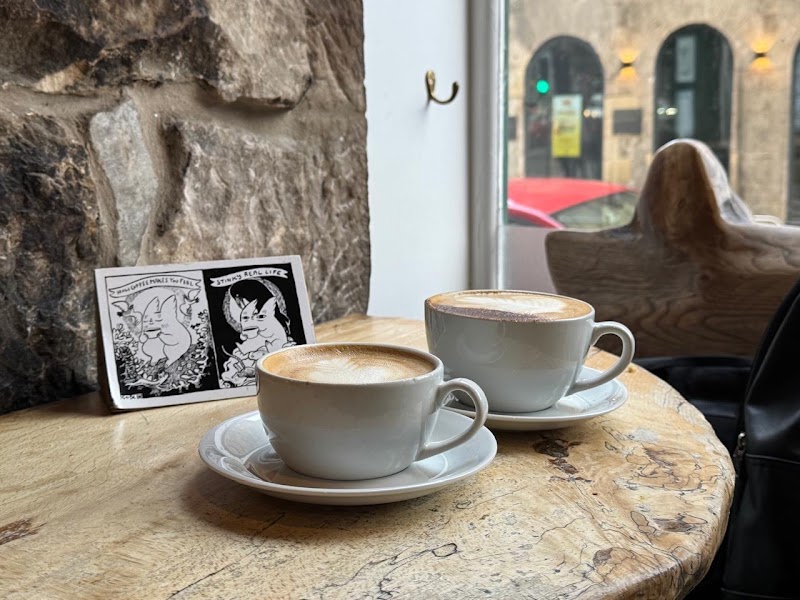
The coffee is not roasted on the premises, and the café makes no claim that it is. The beans are Griffin, also sold under the name Espresso Classico, a blend built by the Edinburgh Tea and Coffee Company and described by its roaster as medium-dark and velvety, with nutty and chocolate overtones and a suggestion of plum and cherry underneath. That is worth knowing before you order, because it tells you precisely which school of coffee you are walking into.
A medium-dark blend of that kind is designed for milk and for volume. It gives you a flat white with body and a cocoa-ish sweetness rather than the sharp, tea-like acidity a light Nordic roast delivers, and it holds its shape when the counter is three deep and drinks are going out one after another. It is also forgiving: it tastes like itself whether you take it black, long, or buried under steamed milk. What it is not is a rotating single-origin programme with a tasting-note card and a producer’s name chalked on the board. If that is what you came to Edinburgh for, the city has bars built around exactly that, and this is not one of them — nor has it ever pretended to be.
The rest of the drinks board goes wide rather than deep. The syrup range runs to roughly two dozen, taking in the expected cold-weather flavourings and a few genuinely unexpected ones, which tells you the room serves a student and office crowd with broad tastes rather than a self-selecting group of coffee obsessives. Very little about brew-bar kit or hand-poured filter is documented publicly, so treat espresso and milk drinks as the dependable core of the offer and anything else as a bonus.
Who is behind it
Unusually for a café this well known, the people who founded it have kept themselves out of the story. Its own account of itself skips the founders entirely and credits instead the many years of people who have passed on both sides of the counter — a slightly sentimental line, but a truthful description of how a business of this age actually accumulates a character. There is no founder interview to send you to, no origin myth involving a trip to a farm, and no roaster-owner personality bolted onto the brand. For a place that opened in the late nineties, long before hospitality was expected to perform its backstory online, that is entirely normal.
The one name worth carrying with you is the roasting partner. Handing the house blend to the Edinburgh Tea and Coffee Company is a decision you can taste, and it is a local relationship rather than a national supply contract, which counts for something in a city that takes its independent roasteries seriously. The same blend is sold in bags to take home, and it turns up in at least one other long-established Edinburgh tea room, so the house style is not a secret kept behind this particular counter.
What kind of visit it suits
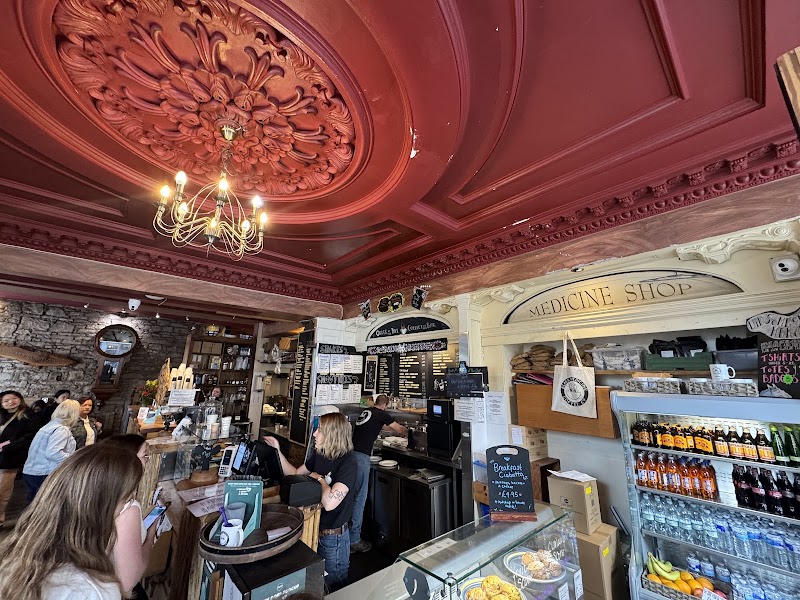
This is, before anything else, a place to sit for a long time. The building gives you two quite different rooms in which to do it, and choosing correctly matters more here than in most cafés. The ground floor is the working coffee bar: the queue, the grinder, milk being steamed, people in and out with cups to carry away. Go down the stairs and the whistling of the steam wand and the whirr of the blender fall away into ordinary conversation.
For laptop work the cellar is the obvious answer, and the café is openly relaxed about the idea — it offers the space for study sessions and coffee mornings, which is about as clear a signal as a business can give that nobody is going to glare at you over a second cup. The corollary is that in term time you are competing for those tables with several hundred people who arrived with exactly the same plan, and sockets in an old stone basement are finite. If mains power is essential to your afternoon, come early in the day rather than after lectures.
For conversation, the upstairs benches and window seats work better than they look, because the general hum gives you cover. For coffee to carry out it is quick and unfussy, and the position at the top of the Southside makes it a natural stop before a lecture, a museum or a show. And for sitting alone with a book, few rooms in central Edinburgh do it better: dim, warm, wooden and entirely indifferent to how long you stay.
The room and the atmosphere
The frontage is dark green and easy to walk past if you are not looking for it, which after all these years is part of the charm. Inside, the material palette is stone and wood and very little else: exposed walls, chunky timber tables and chairs, a wooden floor, ceilings painted in deep, saturated colours that swallow the light rather than bouncing it around. The effect is cave-like in the best sense — autumnal, sheltered, the opposite of the white-tiled brightness that the last decade of coffee design has standardised.
Seating is varied enough that solo visitors and small groups are both properly served: substantial benches, single window seats for one person and a book, and odd little side tables that would look wrong anywhere else. The cellar is the quieter of the two floors and is where most people settle in for the long haul; upstairs is busier and more transactional, with a steady flow past the counter. Between the two levels there is a decent amount of seating for a central Edinburgh café, though at peak it still fills.
Because the room hosts private functions and organised study sessions, there will be occasions when part of the space is committed to a group. That is worth bearing in mind if you are planning to work here on a specific afternoon rather than simply dropping in.
What comes with the coffee
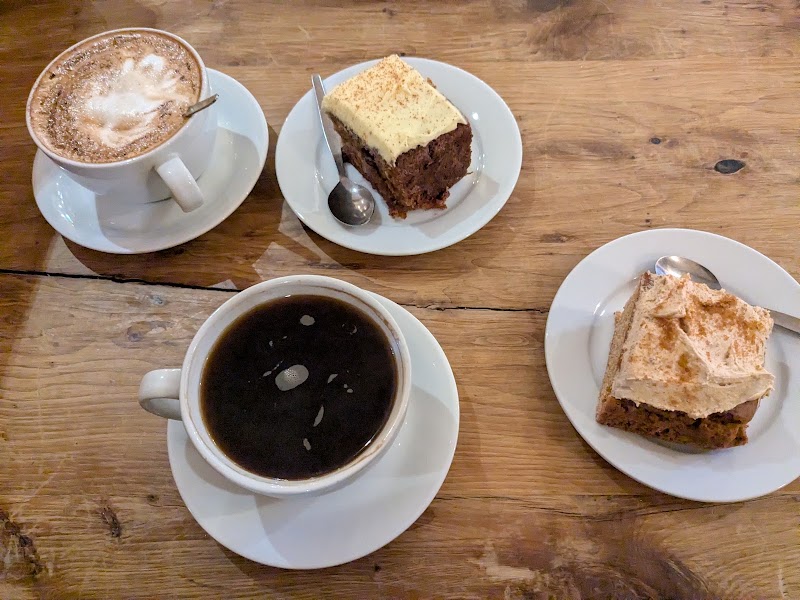
The food operation is a counter, not a kitchen. Savoury bagels and cakes sit out at the front, with vegan options among them, and it is put together for people who want something alongside a cup rather than a proper sit-down meal. Nothing in the café’s public material states whether the baking happens on the premises or comes in from a supplier, so it is safer to assume the latter than to credit it with a bakery it has never claimed.
The practical reading is simple: this is a coffee house that feeds you adequately, not a brunch destination. Come for the coffee and the room, treat lunch as a convenience, and if you want an ambitious plate of food, eat elsewhere in the Southside and come here afterwards.
When to come
The doors open well before the working day begins, which makes it a genuine morning café rather than one that surfaces mid-morning for tourists. Early is also the calmest part of the day and the best window if you want the cellar to yourself.
Term time reshapes the place completely. From the afternoon onward the lower room belongs to the university, and the closer the city gets to exam season the more that is true. Out of term, and through the middle of summer, mornings are noticeably easier. August is the exception in the other direction: with the Festival Theatre a minute away and the university’s venues all around, the whole quarter is at full stretch for the duration of the festival, and a café this well established absorbs a great deal of that traffic.
Weekends bring shoppers and visitors rather than students, which changes the tone more than the volume. The building keeps the same rhythm every day of the week, so there is no weekday-only trap of the kind you get in cafés built around office trade.
Getting there
The café sits at the northern end of the Southside, on the seam where the Old Town runs into the University of Edinburgh’s central campus. Old College is a few paces away, the National Museum of Scotland is a short walk to the west, Surgeons’ Hall is just to the south, and the Festival Theatre is close enough to make this a standard pre-show coffee.
Edinburgh has no underground, so arrival is on foot, by bus or by tram. The main railway station is roughly ten minutes away, uphill on the way back; the tram line runs along the New Town’s main shopping thoroughfare, which leaves you a similar walk. Buses from every direction converge on the bridges immediately outside, and the corridor here is one of the busiest in the city for public transport, so getting to it is rarely the problem. Parking, on the other hand, is genuinely difficult in this part of town and not worth attempting.
Good to know
The room is dark by design. If you need daylight to work or you are photographing your own laptop screen for an hour, that is a real consideration rather than a stylistic quibble. The window seats upstairs are the brightest position in the building.
Tables are not reservable for individuals, so a busy afternoon means waiting or moving on — although the two floors mean the place looks fuller from the door than it usually is, and it is always worth checking downstairs before giving up. The espresso is a settled, milk-friendly blend rather than a lively single origin, and the drinks board reaches further into flavoured territory than a specialty purist will enjoy. And the café is quiet about itself online: little is published about its founders, its brewing kit or its suppliers beyond the roastery, so anyone hoping to research it thoroughly before visiting will find the history thinner on the page than it is in the room.
Questions and answers
How long has Black Medicine been open?
Since 1998. It began upstairs in the same building and later expanded downwards into the cellar, and it has outlived several satellite branches that opened and closed over the years.
Where does the name come from?
From the idea that the native peoples of America once referred to coffee as black medicine. The café explains it that way itself and has kept the name unchanged.
Who roasts the coffee?
The Edinburgh Tea and Coffee Company. The house espresso is its Griffin blend, a medium-dark roast with nutty and chocolate character. The café does not roast on site.
Is it a good place to work on a laptop?
Yes, and the basement is the room to aim for. The café actively offers its space for study sessions, so working here is expected rather than tolerated. Competition for tables and sockets is fierce during term.
Is it noisy?
The ground floor is, in a pleasant coffee-bar way. The lower floor is markedly calmer, and the difference between the two levels is the single most useful thing to know before you walk in.
Does it serve proper food?
It serves counter food — savoury bagels and cakes, with vegan choices — rather than cooked dishes. It is a coffee house first, and there is no indication that it operates a full kitchen.
Is it suitable for a group?
Small groups, yes, thanks to the benches and larger tables. For anything organised, the café hires the space out for private functions, which is the route to take rather than turning up in numbers unannounced.
Is it worth a detour for a visitor rather than a student?
Yes, if you value rooms with a history over coffee-competition technique. It is one of the last cafés in central Edinburgh that still looks and feels the way independent coffee looked before the third wave standardised everything, and it is a minute from the Old Town.
Opening hours
| Day | Hours |
|---|---|
| Monday | 07:30–19:00 |
| Tuesday | 07:30–19:00 |
| Wednesday | 07:30–19:00 |
| Thursday | 07:30–19:00 |
| Friday | 07:30–19:00 |
| Saturday | 07:30–19:00 |
| Sunday | 07:30–19:00 |
Photos
Visitor reviews
Reviews last updated: 2026-08-10 17:32:52
Data is refreshed monthly. Sources: edinburghka.com and editorial picks based on reviews.
Унікальна незалежна перлина! Подобаються сільські, затишні дерев'яні інтер'єри та чудова богемна енергія цього закладу. Вегетаріанський пакора-бейгл – це чудове, пікантне поєднання, яке ідеально поєднується, а матча-лате…
Досить людна кав'ярня, але внизу є додаткові місця для сидіння, які ви можете не помітити одразу. Зверніть увагу, що там також трохи тісно, оскільки столики розташовані досить незручно. Але, чесно кажучи, веселий декор…
Безліч місць для сидіння, як нагорі, так і внизу. Чудова атмосфера, щоб як попрацювати, так і поспілкуватися з друзями. Обидва рази, коли я був там, було порівну обидва типи груп. Дуже легко провести там годину+ в одну м…
Це кафе – чудове місце, щоб розпочати день, попрацювати або поспілкуватися з друзями. Дерев'яні столи та декор створюють затишну атмосферу, як і чудове обслуговування (тут навіть є повнорозмірний тотемний стовп).
Сидіти…